Sign in. It’s quick, free and it’s up to you.
An account is an optional way to support the work we do. Find out more.
Sign in. It’s quick, free and it’s up to you.
An account is an optional way to support the work we do. Find out more.
ONE IN THIRTY private drinking water supplies failed to meet the drinking water standards, compared to one in 734 public supplies, in 2022.
The Enviornmental Protection Agency (EPA) has said “urgent action” is needed to improve the quality of drinking water from private supplies and said that compliance has not improved.
Almost 200,000 people get their water from 380 private group schemes, which are set up by local communities to manage abstraction, treatment and distribution of treated water and are generally supplied by springs or wells.
Small private supplies serve commercial premises like hotels, pubs and restaurants, crèches and national schools. The owner manages the abstraction, treatment, and delivery of the water, which is also mostly supplied by wells.
The EPA says there are 1,700 small private supplies registered with local authorities, but the total remains unknown as not all have taken the steps to register. Local authorities are required to monitor these supplies as well.
In 2022, 84% of registered supplies were monitored, compared to 75% in 2021, but, according to the EPA, “the results highlight ongoing issues with the quality of private drinking water supplies”.
Fourteen private group schemes were found to have E.coli contamination. The EPA says that this finding indicates that “the water supply has not been properly disinfected”.
The agency said that the failure to properly disinfect these supplies put the health of approximately 5,500 people, that use the drinking water, at risk.
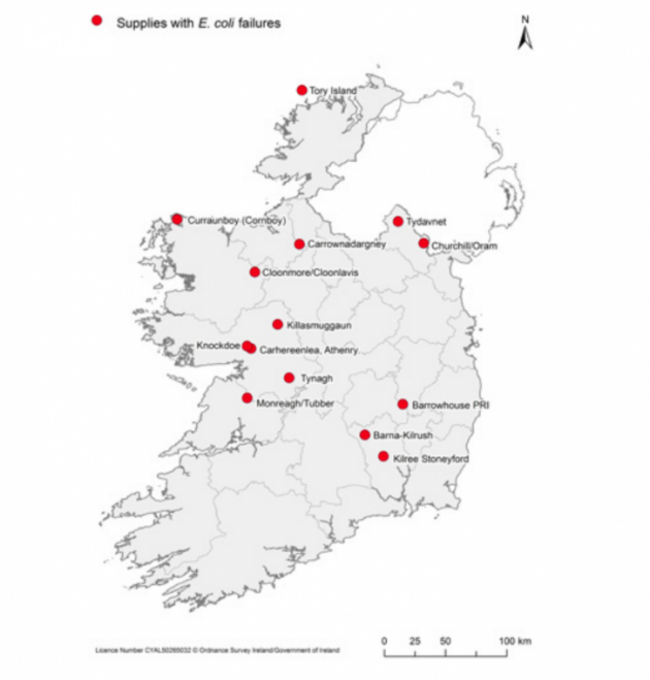
In 2020, it was found that one in twenty private water supplies were contaminated with E. coli. That report found 49 of the 1,225 small private supplies were found to be contaminated.
This year’s report found there were more small private supplies (1,700) in the country, as well as less E. coli contamination.
However, the Director of the EPA’s environmental enforcement office, Dr Tom Ryan, suggests that “private drinking water quality hasn’t improved in recent years”.
The legal threshold of trihalomethanes (THMs), 100 microgrammes, was exceeded by 16 private drinking wells, supplying 14,000 people.
THMs are formed when vegetation and other natural matter reacts with chlorine during disinfection treatment. The EPA said that actions to prevent THMs for exceeding the legal limits must be prioritised by suppliers.
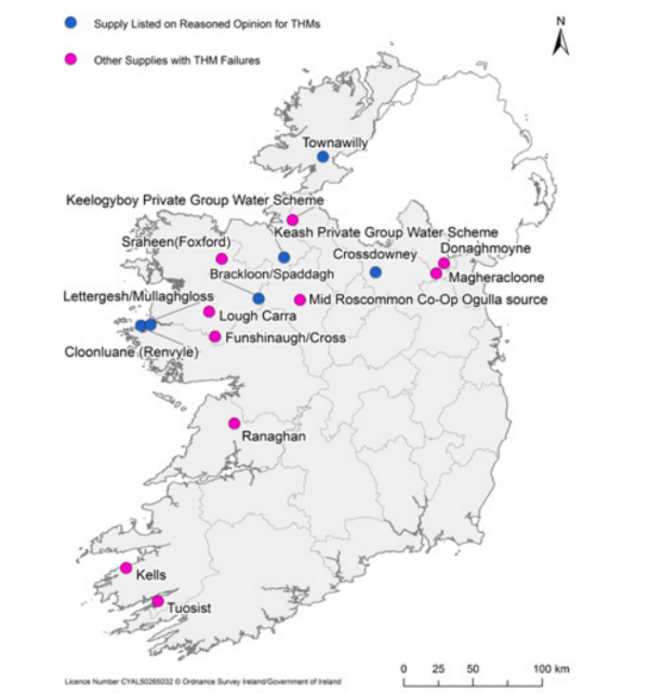
A slight improvement was seen in THMs compliance in 2022, when compared to 2021. Both levels remain above 90% – with 94.7% compliance across private group schemes last year.
Despite public funding being made available to support any upgrades to these schemes, Dr Ryan said, the lack of improvement remains a “local public health concern”.
“In addition, as there is no legal requirement to register private drinking water supplies, it is not possible to quantify the full extent of the risk to public health,” he said.
Dr Ryan called for the registration of these supplies to be made a “legally enforceable obligation” for suppliers.
Failure by water suppliers to register was among the key issues identified in the government review of the rural water sector and these need to be addressed.
A review of the rural water sector was completed by the Department of Housing, Local Government and Heritage earlier this year. Its findings concluded that there are a number of issues around the registration, compliance and management of these supplies.
Noel Byrne, the programme manager in the EPA’s environmental enforcement office said it is “crucial” that the issues found in the report are addressed “so that private water supplies meet required standards and public health is protected”.

To embed this post, copy the code below on your site













have your say